


Great! You have decided to make some lifestyle changes for better health, but where to start? Making healthy dietary choices can help you stay active and feel your best, as well as help lower your risk of developing some health conditions that are common among adults. To assist you on your journey to better nutrition, the FDA has a tool to help you make informed decisions about the food you buy called the Nutrition Facts Label.
You can find the nutrition facts label on packaged food and beverages. There’s a lot of information packed into that tiny label, and it can sometimes seem confusing and hard to sort out. Here are some tips on reading the nutrition label so that you can make healthier eating choices.
Serving Sizes
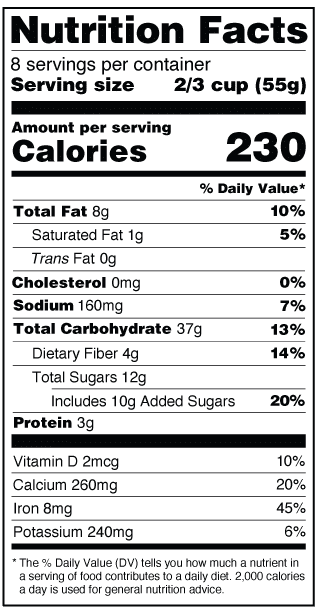
The first item listed on the nutrition facts label is serving size and number of servings per container. It’s important to pay close attention to this number as the nutrition information listed on the label is typically based on one serving of the food. When it comes to serving size, you will want to keep the following things in mind:
- Though the serving size is based on the amount of food a person would typically consume, it is not a recommendation of how much you should eat or drink.
- One package of food can contain multiple servings, and some labels may list information for both a single serving and for the whole package in two columns.
- The label also lists the number of servings total, so you can see how many servings are in the entire package.
Calories
Next on the label, listed in big bold print, are calories per serving. Calories can be important when you are trying to balance the amount of energy-producing calories you consume vs the number of calories you burn. The calories your body needs can vary depending on your age, sex, weight, height, and level of physical activity. Two thousand daily calories is often used as a general guide number, but you can check with your primary care doctor or nutritionist to determine your calorie needs.
Nutrients
This part of the label shows some of the key nutrients that impact your health so that you can track the nutrients you want to increase or decrease in your diet depending on your needs.
For example, sodium, saturated fats, and added sugars are often nutrients that people want to limit, as overconsumption of them has been associated with an increased risk of adverse health effects such as diabetes and heart disease.
While limiting some nutrients, you may want to increase others, such as dietary fiber or protein, which are also listed. Dietary fiber cannot be easily digested and can help speed up the movement of food through the digestive system, increasing the frequency and ease of bowel movements. Protein can be important for building healthy muscles.
Vitamins and Minerals
Since people are often deficient in these nutrients, the following are listed at the bottom of the label:
- Vitamin D
- Calcium
- Iron
- Potassium
Manufacturers can also voluntarily list other vitamins like A and C.
Diets that include higher amounts of vitamin D, calcium, iron, and potassium can reduce the risk of developing osteoporosis, anemia, and hypertension (high blood pressure). For more information on the nutrients you need, talk to your family doctor, visit a nutritionist, or check www.myplate.gov/ . The nutrition label includes the amount of each nutrient per serving in milligrams or micrograms, as well as the percent of the daily value.
Percent of Daily Value
The tiny note at the bottom of the nutrition label explains that “The % of daily value (DV) tells you how much a nutrient in a serving of food contributes to a daily diet. 2000 calories a day is used for general nutrition advice.” This can make tracking your daily needs easy if you are on a 2000-calorie-a-day diet.
The DV% can also be useful in helping you to compare your food choices. Just be sure the serving size of each product is the same. Look at the daily value of the different nutrients and choose the product that contains more of the nutrients you want and less of those you don’t.
If you are tracking nutrient intake for the purpose of managing a specific health condition or dietary goal, such as sodium for high blood pressure, or carbohydrates and sugar for diabetes, you will want to look at the exact amount of the nutrient instead of the daily value.
The nutrition facts label of packaged food and beverages can be a valuable tool in your quest to make healthier dietary decisions. Before beginning any new diet or nutrition regimen, it’s a good idea to consult your primary care doctor or a nutritionist.
Tips to using the Nutrition Facts Label effectively
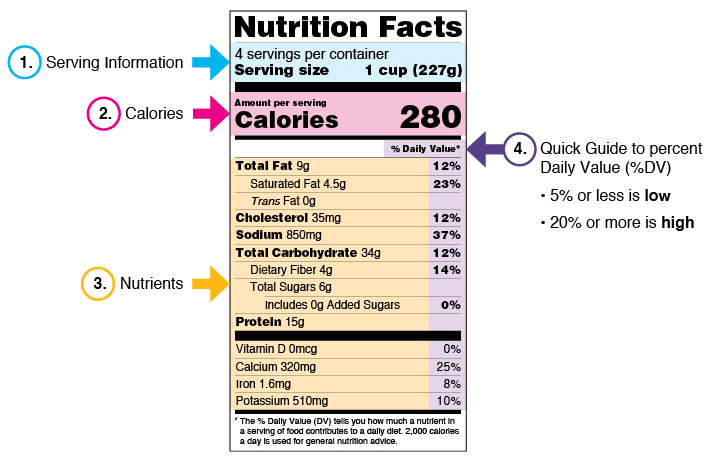
- Start by looking at the serving size. This is what the subsequent information is based on.
- Then check the calories per serving to help balance the amount you are consuming with the amount you are burning.
- Look at the nutrients – In general, choose foods that are higher in dietary fiber, vitamin D, calcium, iron, and potassium. Consume less saturated fat, sodium, and added sugars. The amounts of these nutrients are all listed on the label per serving size.
- Use the % of daily value column to compare foods to get the nutrients you want.
If you’re considering a dietary change and have questions or concerns, contact River Bend Medical Associates for an appointment. As part of your healthcare team, we are here to provide you with the best care in all aspects of your primary care, including helping you to meet your healthy lifestyle goals. For more information on our medical practice, or to make an appointment, contact River Bend Medical Associates or call 916-392-4000.